
Montgomery County Arrest Records and Charges
An arrest record is the account of the arrest itself. It notes the arresting agency, the date, the basis for taking the person into custody, and the booking at the jail. In Montgomery County, local arrests are made by the Sheriff's Department and city police, and the Sheriff's Department at 662-283-3343 can confirm whether someone is held in local custody. An arrest is only the first step. It is not proof of guilt, and it does not by itself set the formal charges.
The court charge record begins later. After an arrest, the prosecutor decides what to file. For felonies, that prosecutor is District 5 District Attorney Adam Hopper, reachable at 662-226-8545, who brings cases in Circuit Court. For misdemeanors and traffic matters, local prosecutors handle charges at the Justice Court and municipal level. The charges a prosecutor files become the official court charges after arrest, and the clerk tracks them through the case. The booking side and the jail roster sit with the custody records, so the inmate records page covers booking detail and current custody. The full case file, pleadings, and final outcome live with the criminal court records page.
How to Find Montgomery County Arrest Records and Charges
Montgomery County does not run a single public website that lists arrests and charges together. There is no county mugshot database and no online booking log. Records sit office by office, so the right channel depends on the stage of the case. Start with the arrest, then follow the charge to the court that holds it.
- Confirm custody and booking with the Montgomery County Sheriff's Department at 662-283-3343. Ask whether the person is held locally, the arrest date, and the listed charge.
- Check the court level. Justice Court at 662-283-2290 handles misdemeanors, traffic citations, and felony preliminary matters. Felony cases that move forward are filed with the Circuit Clerk at 662-283-4161.
- Open the case with the clerk and read the charge list. Each charge ties to a statute and shows the level and the current status.
- For charging decisions on a felony, contact District 5 District Attorney Adam Hopper at 662-226-8545, since the prosecutor controls what is filed and amended.
State systems fill the gaps. For someone sentenced to state prison, the Mississippi Department of Corrections inmate search at mdoc.ms.gov looks up custody by name or MDOC ID. When a record is not online or not available by phone, the Mississippi Public Records Act gives a written fallback. Under Mississippi Code Section 25-61-5, any person may request to inspect or copy public records, and access is generally due within one working day after a written request if the office has no separate procedures.
County notices and contact details change, so it helps to check the source the county keeps current. The official county news and notice page posts updates that can affect court access and office hours.
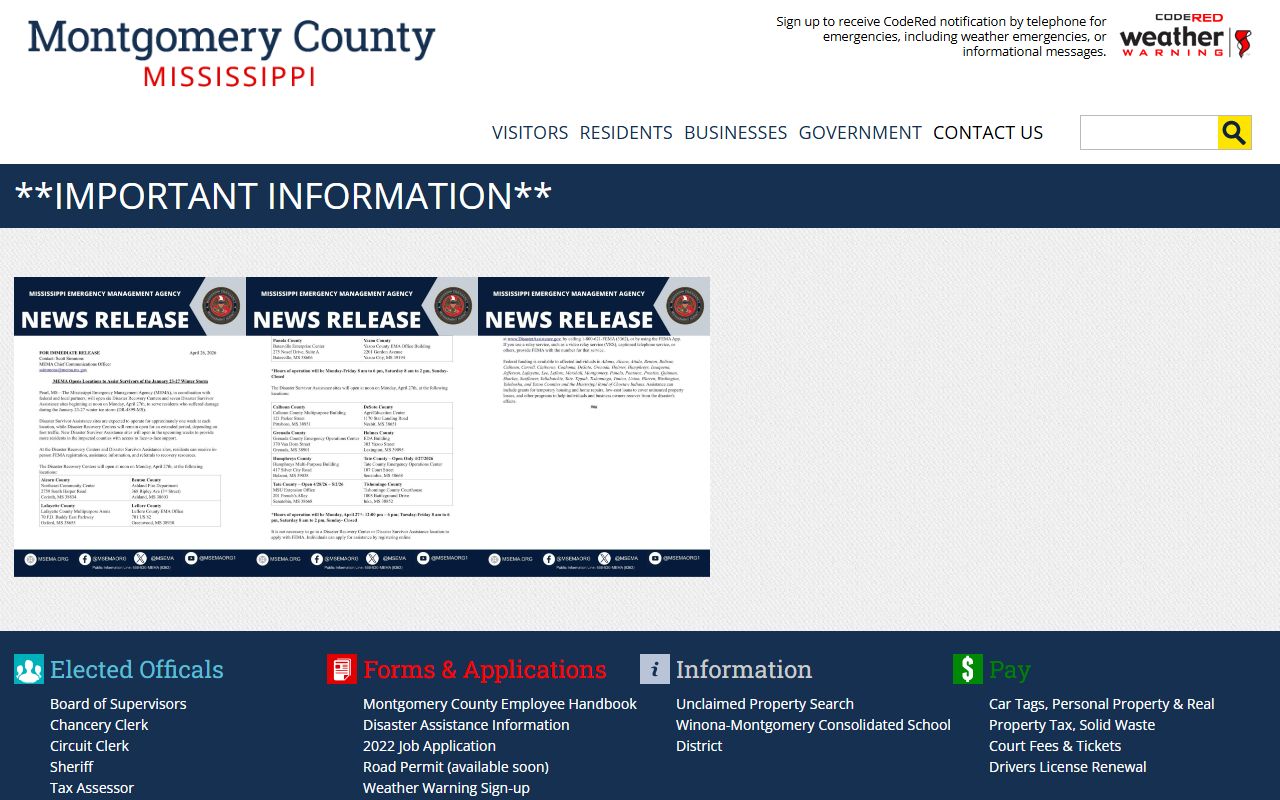
The notice page will not return an arrest record, but it confirms phone numbers, mailing addresses, and current office details before a request goes out. Verifying the channel first saves a wasted call or a misdirected letter.
How Charges Get Filed After an Arrest
Walk the path from the arrest forward. A person is booked, and at that point there is an arrest record but not yet a finished set of court charges. The charge record begins when a prosecutor files a charging document with the court. That document names the offense, ties it to a statute, and starts the formal case. Mississippi uses three main charging documents, and the one used depends on how serious the offense is and which court hears it.
| Complaint | Information | Indictment | |
|---|---|---|---|
| Filed By | Officer or prosecutor | Prosecutor | Grand jury |
| Common For | Misdemeanors and traffic | Some felonies by waiver | Serious felonies |
| What It Is | A sworn accusation that states the charge | A prosecutor's written charge without a grand jury | A formal felony charge returned by a grand jury |
| Where It Starts | Justice or Municipal Court | Circuit Court | Circuit Court |
In Montgomery County, a misdemeanor or traffic matter often begins with a complaint or citation in Justice Court or Winona Municipal Court. A felony usually begins as a preliminary matter, then matures into an indictment returned by a grand jury and filed with the Circuit Clerk. The Circuit Clerk, Robert M. Perry, receives indictments and the criminal papers that follow. An indictment is an accusation, not a verdict, and the case still has to be proven.
Charge Status in Montgomery County Records
Charges do not stay frozen. As a case moves, a charge can be amended, reduced, added, dropped, or dismissed. A single arrest may produce several charges, and each one can carry its own status. Reading the status tells you where a charge stands right now, which matters more than the original booking charge. The terms below show up often in Mississippi criminal case records, including the docket flags used in the Fifth Circuit electronic system.
| Status | What It Means |
|---|---|
| Pending | The charge is active and the case is still moving toward a plea, trial, or other outcome. |
| Amended or Reduced | The prosecutor changed the charge, often to a lesser offense, so the original count no longer applies as filed. |
| Dismissed | The court ended the charge. A dismissal with prejudice cannot be refiled, while one without prejudice may return. |
| Nolle Prosequi | The prosecutor formally chose not to pursue the charge, dropping it from the case. |
| Bound Over | A lower court found probable cause and sent the felony charge forward to the grand jury and Circuit Court. |
Status changes are a normal part of any case. A charge filed at arrest may look very different by the time it reaches a final disposition. Because the prosecutor controls charging, questions about why a charge was amended or dropped go to the District Attorney for felonies or the local prosecutor for misdemeanors, not to the clerk.
Charges Versus Convictions
Being charged is not the same as being convicted. A charge is an accusation. A conviction is a final result reached by a guilty plea or a verdict. Many Montgomery County arrest records lead to charges that are later reduced, dismissed, or never proven. Treating a charge as a finding of guilt is a common and serious mistake, and it is one reason these records carry legal limits on how they may be used.
| Charge | Conviction | |
|---|---|---|
| Stage | Accusation | Verdict or plea |
| Burden of Proof | Probable cause | Beyond a reasonable doubt |
| Decided By | Prosecutor who files it | Judge or jury |
| Public Record | Yes, unless restricted | Yes, unless restricted |
The gap between the two stages is where most of a case actually happens. Pretrial motions, plea talks, and hearings all sit between the charge and any conviction. The court file shows that path, so the disposition, not the arrest charge, is the part that tells you how a case ended.
Sealed Versus Expunged Charge Records
Some Montgomery County charge records are restricted by court order. Sealing and expungement both limit public access, but they are not the same. A sealed record still exists and stays hidden from general public view, with limited access for certain agencies. An expunged record is treated as though it never happened, and it is removed or destroyed under the terms of the order. Mississippi courts use both, and a granted order is what directs clerks and agencies to restrict the file.
| Sealed | Expunged | |
|---|---|---|
| Visibility | Hidden from the public | Destroyed or treated as never existing |
| Law Enforcement | Limited access | Very limited access |
| Eligibility | Set by the court that handled the case under Mississippi law | Often dismissals, certain first offenses, or completed diversion, subject to court review |
To pursue either, start with the court where the case was handled, which may be Justice Court, Circuit Court, or Winona Municipal Court depending on the charge. A petitioner gathers the case number, arrest date, charge, and proof that fines and sentence terms are complete, then files in that court. A public-records request cannot unseal a restricted file. The requester must qualify under the relevant law or hold a court order.
Charge Codes and Severity Levels
Each charge in a Montgomery County record points to a specific Mississippi statute. The statute code identifies the offense, and the level sets how serious it is. The three broad levels are felonies, misdemeanors, and minor infractions. A felony is the most serious and is prosecuted in Circuit Court, where most cases are heard by a jury. A misdemeanor is less serious and is handled in Justice Court or Winona Municipal Court. Traffic citations and small infractions sit at the lighter end.
One arrest can produce several separate charges. A single stop might generate a felony count, a related misdemeanor, and a traffic citation, each with its own code, level, and status. Reading a charge record means checking each count on its own rather than assuming the booking line tells the whole story. The level also decides the path. Felony counts move toward an indictment in Circuit Court, while misdemeanors stay at the lower court level unless appealed.
Statewide Charge and Criminal History Lookups
Some charge information rolls up into statewide systems rather than a county page. Mississippi Electronic Courts, the state e-filing system, hosts Circuit Court records, and the Montgomery County Circuit Court went live on the system on December 14, 2020. Public document access runs through Public Access to MEC, which requires registration and credentials. The portal is reachable through courts.ms.gov, with a help desk at 601-576-4650 and helpdesk@mec.ms.gov.
Other state resources cover related needs. The Mississippi Department of Corrections inmate search reports state-prison custody for sentenced offenders. Mississippi VINE at vinelink.vineapps.com offers custody status and notification. For driving consequences tied to a traffic charge, the Department of Public Safety keeps the motor vehicle record, which is separate from the court case file. The court file shows the citation, plea, and disposition, while the driver record shows the license impact.
Background Check Considerations
There is a real difference between a casual records lookup and a formal background check. A background check used for hiring, housing, credit, or insurance is governed by the federal Fair Credit Reporting Act, which sets rules on accuracy, consent, and dispute rights. A casual search of public charge records carries no such protections and no guarantee that the data is current or complete. Charges get amended and dismissed, so a raw charge line can mislead anyone who treats it as a final outcome.
Important: This site is not a consumer reporting agency under the Fair Credit Reporting Act, and its records may not be used for employment, tenant, credit, or insurance screening.
Restricted Charge Records in Montgomery County
Not every charge record is open to the public. Youth Court matters involving juveniles are confidential under Mississippi law and are disclosed only by court order. Sealed and expunged charges are restricted by the order that closed them. Dismissed charges may still appear unless an expungement removes them, and records tied to an active investigation can be withheld while the case is open. Adoption and mental-health commitment files, handled through Chancery Court, are also treated as sensitive rather than open court records.
When a charge does not show up where it should, the cause is often a restriction rather than a missing file. An outstanding charge may also tie to a warrant issued by the court that handled the missed appearance or unpaid fine. For anything that is not online, the public-body office that holds the record remains the surest route, with the Public Records Act as the written fallback.